

How and Why Haitians Cope with Capitalism Differently in the Diaspora than in Haiti
hy don’t many Haitians “see” capitalism in Haiti?
Many compatriots still living in Haiti say, with quiet weariness or resigned irony: “Capitalism is hard elsewhere. Here, we survive differently.”
They’re not wrong. But they don’t fully understand what they don’t see.
In Haiti, capitalism is neither absent nor dominant. It is incomplete, fractured, dislocated, poorly established, and, above all, not all-encompassing. And it is precisely this incompleteness that creates the illusion.
Capitalism as it functions in the imperialist metropoles of North America and Europe — the kind that leaves no room for growth — never truly takes hold. It stopped halfway and failed to become all-encompassing.
And in this failure, something still breathes.
I. In Haiti, Capitalism Does Not Yet Encompass All of Life
In Northern societies, capitalism is all-encompassing. It doesn’t just structure the economy. It organizes time, the body, sleep, health, housing, relationships, emotions, and the fear of becoming destitute. There is nothing outside of it. Even love is conditional.
In Haiti, this threshold has never been fully crossed, not through conscious resistance, but through structural incapacity.
The state doesn’t collect so little out of fiscal justice. It collects so little because it cannot collect more.
Electricity arrives like an unexpected visit, then disappears without explanation. Water flows, then recedes like a broken promise. A road begins, then work on it stops. Administration happens in fits and starts, never as a continuous system.
Bills don’t punctuate life. Sometimes they don’t even exist. This isn’t a political project. It’s an inherited disorder. But this disorder produces a major political effect: survival is not entirely captured by the market.
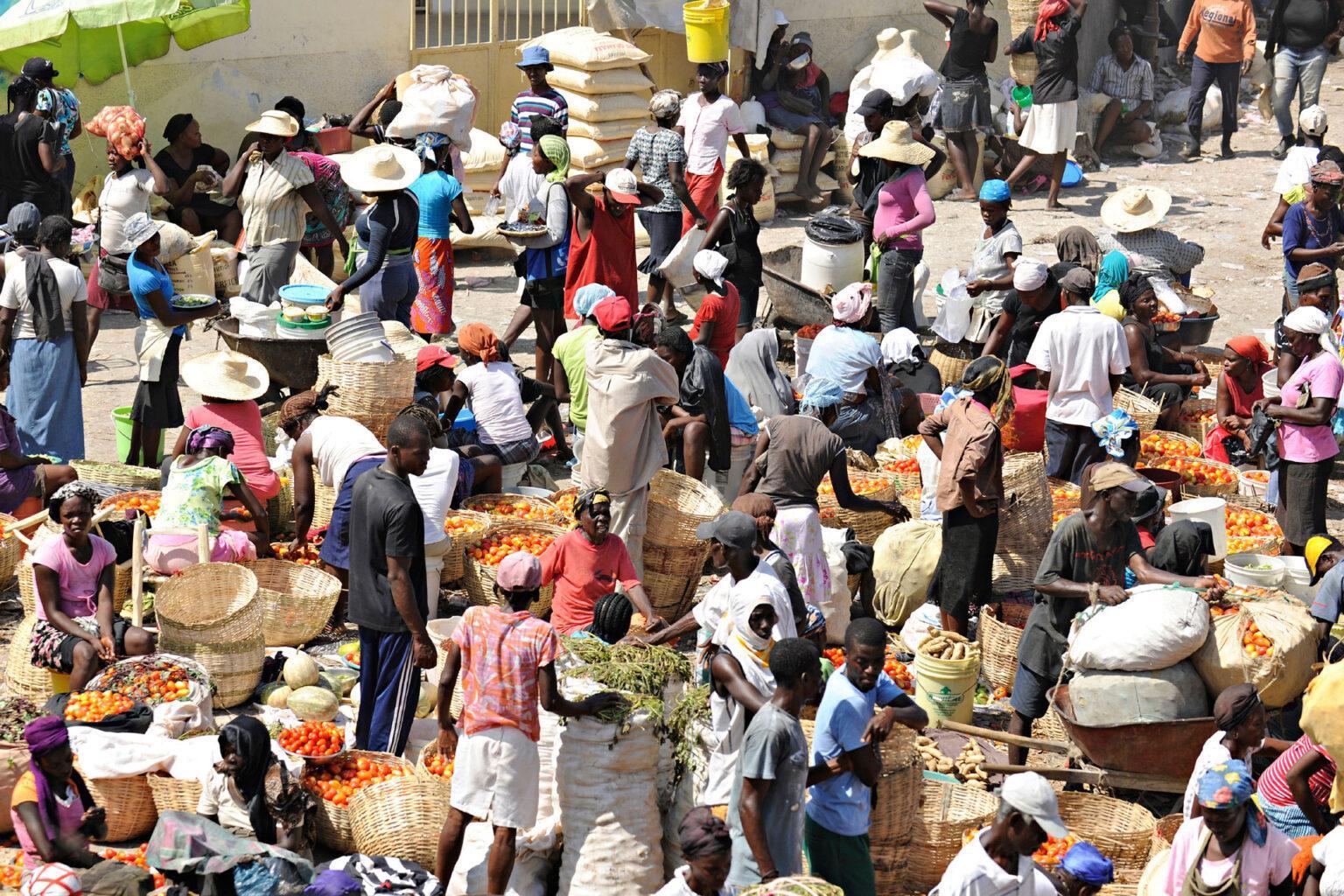
Work is not confined to “the company.” It is dispersed, improvised, fragmented: street economy, small businesses, multiple activities, unstable incomes, and daily makeshift solutions.
Life is hard. But it is not locked into a single system.
The question is no longer simply: Do you work? But: How do you live? With whom? In what dependencies?
II. Survival in Haiti Does Not Depend Exclusively on the State or on Wages
In Haiti, to survive — not to live well, but to survive — one does not depend on a single contract, a single salary, a single bank account, a single institution.
If one thing fails, everything does not collapse immediately.
Survival is fragmented. It rests on several fragile supports: the extended family, the neighborhood, resourcefulness, informal networks, and non-monetary forms of solidarity.
It’s not security. It’s the plurality of support systems. Life is precarious, but it holds on in many places.
III. Falling Ill in Haiti: a Revealing Example
When someone falls ill in Haiti: the mother intervenes, the aunt contributes, the neighbor lends, the community adjusts its help, roles are redistributed — the burdens are shared.
The crisis isn’t “resolved.” It’s absorbed collectively. It’s exhausting. It’s unfair. It’s sometimes humiliating. But it’s not entirely privatized.
IV. Haitian Women and Informal Autonomy
In Haiti, thousands of women sell, trade, produce, negotiate, and survive on their own. Not through ideological emancipation. Out of vital necessity.
Their survival does not depend solely on a salaried husband, a stable man, or a secure nuclear family. They fall, they get back up, they fend for themselves. Men do not bear the economic burden alone. The family cushions the blow. The community absorbs the burden.
This is not equality. It is a shared dependence. Precarious. Unjust. But real.
V. The Couple in Haiti: Important, but Not All-Encompassing
In this context, the couple matters, but it is not everything. It is not the only insurance, refuge, or safety net. It coexists with other forms of protection. There is the mother, the aunt, the sister, the neighbor, or the community.
The couple is not yet the central infrastructure for survival in Haiti.
VI. Migrating Is Not about Changing Countries: It’s about Changing Survival Systems
When a Haitian arrives in Canada, the United States, or France, they are not simply entering another territory. They are entering a different survival structure.
In those foreign completely capitalist lands, everything must be paid for and is contractual, individualized, and conditional.
Rent is due every month. Healthcare has a cost. Transportation is mandatory. Time is finite. Status is precarious. Everything has a price.
Community solidarity is no longer structural. It becomes optional. Fragile. Conditional.
Being alone immediately becomes dangerous.
VII. Example 1 – The Haitian Woman Alone in North America
Before (in Haiti), she sells at the market, depends on networks, adapts, and survives without a contract.
After (in Canada/United States/France), rent and insurance are mandatory, transportation is paid for, healthcare is paid for or conditional, and immigration status is precarious.
A delay becomes a fault. An illness becomes a threat. Being alone becomes a life-threatening risk.
The result: the pressure to be in a relationship intensifies. This isn’t romantic. It’s structural. Emotional dependence accelerates. Tolerance for the unacceptable increases.
VIII. Example 2 – The Haitian Man in North America
The Haitian man arrives with an identity shaped by resourcefulness, flexibility, and ingenuity. But late capitalism demands something else: rigid schedules, measured productivity, mechanical regularity, constant performance, and silent endurance.
He is told, “You are a strong, resourceful man.” But he is isolated. He doesn’t know how to verbalize his distress. And he no longer has a supportive community.
The distress produced by this tension is not addressed by the state, nor recognized as a cost of the system. It is poured out into the private sphere.
His partner, if he has one, becomes his only refuge, his only listening ear, his psychological buffer — his therapist.
The result: the dependence is not emotional. It is organized or forced.
IX. The Couple Becomes a Survival Infrastructure
In this fully capitalist context: two incomes = minimal breathing room, a single salary = precariousness, illness = existential threat, separation = material catastrophe.
Many Haitian couples in the diaspora stay together out of necessity, delay the breakup out of fear, confusing connection with survival. Needless to say, relationships are maintained despite violence or strain.
This is not a lack of love. It is an excess of coercion.
X. The Haitian Woman in the Diaspora: An Invisible Pillar
She often juggles paid work, domestic labor, emotional labor, and supporting family members back in Haiti. She becomes the household’s economic pillar, the couple’s emotional pillar, and the transnational pillar of family survival.
This work is unrecognized, unpaid, and normalized as “sacrifice.” Late capitalism thrives on this invisibility.
XI. Solitude as a Social Risk
In Northern societies, being alone is not neutral. It is structurally dangerous.
in late capitalism, survival is individualized, dependency is privatized, and intimacy replaces community.
A Haitian alone in Montreal, Miami, or Paris is perceived as unstable, suspected of failure, and deemed incomplete. Because: without a couple, they have no safety net; without a partner, they are at risk, go broke more easily, and burn out more quickly; and without Haiti’s informal social network, they potentially cost the state.
This is why social pressure encourages couples, stigmatizes aloneness, and pathologizes autonomy.
Control is exercised through norms, not laws.
XII. What Migration Reveals
Many diaspora Haitians say: “Life is hard here, but it was hard in Haiti too. I never understood the system before living here.”
Because in late capitalism, survival is individualized, dependency is privatized, and intimacy replaces community.
The difference is not the hardship. It is the structure.
What Haitians experience by migrating reveals the system’s essence: late capitalism doesn’t impose itself only through taxes, laws, and statistics, but through relationships, through intimate dependence, the transformation of love into economic infrastructure.
The shock isn’t just fiscal. It’s relational and existential.
Conclusion
In Haiti, the informal sector still masks capitalism’s cruel laws and logic. Despite the violence and damage capitalism has done to Haiti’s social fabric, forms of mutual support still endure in Haiti. But as soon as Haitians migrate to the Northern metropoles, the couple becomes a primary condition for survival. That’s where the control of intimacy becomes visible.
The informal survival networks of Haiti are often supplanted by the shock-absorber, the safety net, of a relationship, which becomes a hedge against falling into unemployment, homelessness, and capitalist oblivion.
source: Haiti Liberte
abolitionmedia.noblogs.org/?p=…#capitalism #caribbean #haiti #imperialism

